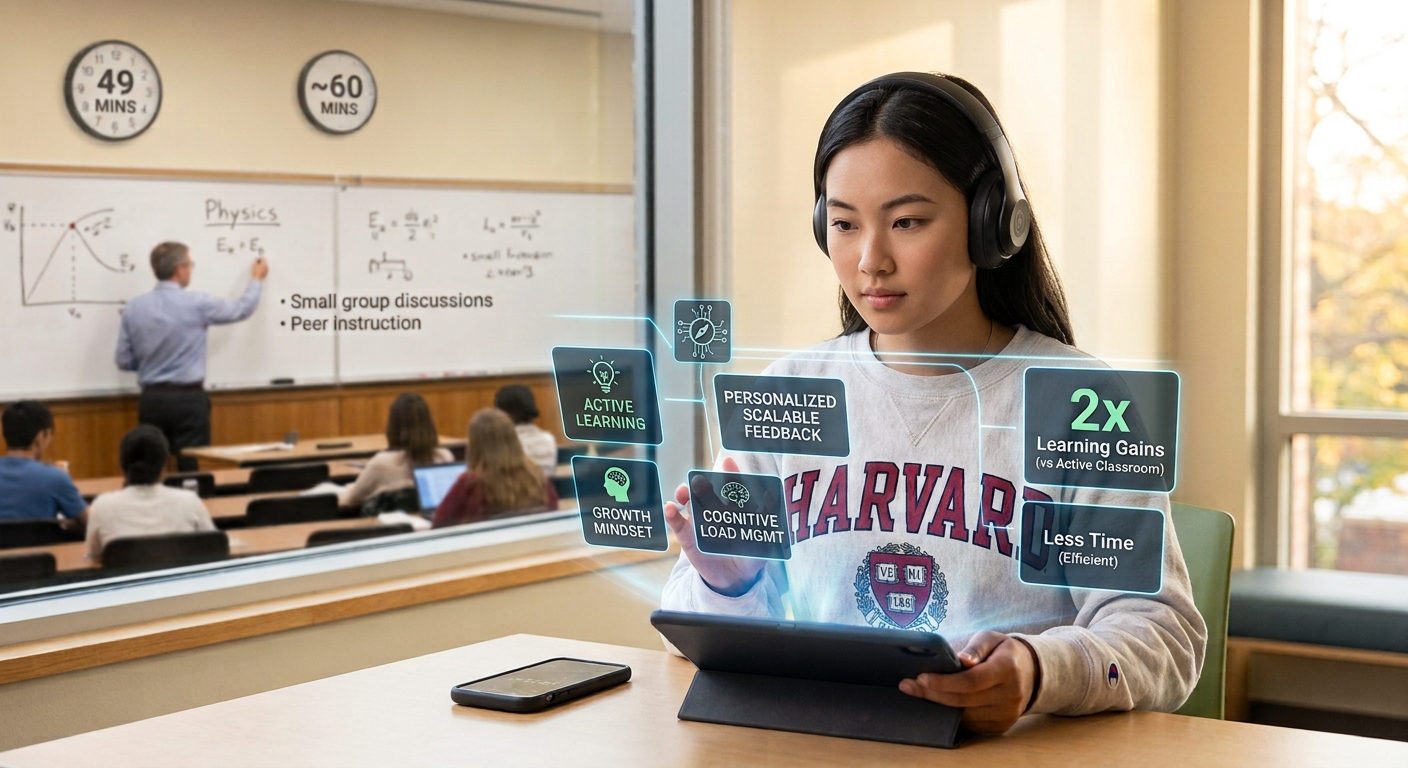
Source: Scientific Reports (Nature) / Harvard Gazette
Full paper: Kestin, G., Miller, K., Klales, A., Milbourne, T., & Ponti, G. (2025). AI tutoring outperforms in-class active learning: an RCT introducing a novel research-based design in an authentic educational setting. Scientific Reports, 15, 17458.
https://doi.org/10.1038/s41598-025-97652-6A landmark randomized controlled trial conducted at Harvard University has delivered one of the clearest pieces of evidence yet that a well-designed AI tutor can outperform even high-quality classroom teaching.
Researchers led by Gregory Kestin and Kelly Miller tested 194 undergraduate students in Harvard's introductory physics course (Physical Sciences 2). Using a rigorous crossover design, every student experienced both conditions: one topic taught through the course's existing research-based active-learning classroom method, and the other through a custom AI tutor called "PS2 Pal."
Key Results
| Metric | AI Tutor | In-Class Active Learning | Outcome |
|---|---|---|---|
| Median post-test score | 4.5 | 3.5 | AI higher |
| Learning gains | More than double | — | AI >2× larger |
| Median time on task | 49 minutes | ~60 minutes | AI more efficient |
| Engagement (5-point scale) | 4.1 | 3.6 | Significantly higher with AI |
| Motivation | 3.4 | 3.1 | Significantly higher with AI |
The difference was highly statistically significant (p < 10⁻⁸). Effect sizes ranged from 0.63 to 1.3 standard deviations after controlling for prior knowledge, topic, and time on task.
Important: The classroom condition was not a traditional passive lecture — it already used proven active-learning techniques. The AI still produced substantially larger gains in less time.
Why the AI Tutor Worked
The researchers did not simply hand students an open chatbot. They engineered the tutor around seven pedagogical principles drawn from learning science:
-
Facilitating active learning
-
Managing cognitive load
-
Promoting a growth mindset
-
Scaffolding multi-part problems
-
Ensuring accuracy of information and feedback
-
Delivering targeted, timely feedback
-
Enabling self-pacing
The system was instructed to guide students step-by-step rather than give full answers, keep responses concise, and encourage effort. Pre-written, verified solutions helped anchor the AI's guidance and reduce errors.
The authors concluded that the biggest advantages came from personalized, on-demand feedback and the ability for each student to move at their own pace — something difficult to achieve consistently in a group classroom setting.
How EduQ AI Puts These Principles into Practice
At Wisdom Link AI, we designed EduQ AI with the same core philosophy: AI should guide students to think, not think for them.
EduQ AI uses a Socratic tutoring approach. Instead of handing over answers, it asks thoughtful questions, offers hints one step at a time, and encourages students to reason through problems. This mirrors the scaffolding and active-learning principles that made the Harvard tutor effective.
Key alignments with the Harvard findings:
-
Guided, not answer-giving
Students stay in the driver's seat of their own learning.
-
Self-pacing
Learners can spend as much or as little time as they need on each concept.
-
Cognitive-load management
Responses are structured and step-by-step to avoid overwhelming students.
-
Growth-oriented language
The tutor encourages persistence and frames struggle as part of learning.
-
Support for writing and practice
Students can photograph handwritten work or generate printable materials, combining the benefits of active practice with AI guidance.
As the Harvard researchers noted, the power of AI tutoring lies not in the model itself, but in how carefully it is designed around proven teaching principles. EduQ AI is built on exactly that foundation.
Looking Ahead
This study strengthens the case that thoughtfully engineered AI tutors can deliver meaningful learning gains — often more efficiently than traditional methods — while increasing student engagement and motivation. The future of education is not about replacing teachers, but about giving every learner access to high-quality, personalized guidance whenever they need it.
Experience AI-Powered Learning with EduQ AI
See how EduQ AI applies these research-backed principles. Try it free for 7 days.
Try EduQ AI Free
Stay curious, stay connected.
– The Wisdom Link AI Team
Related Posts
Handwriting vs. Typing: The Neuroscience Behind Better Learning
NTNU study proves handwriting creates stronger brain connectivity than typing.
Read More
AI's Transformative Role in Education: A Vision from Bill Gates
Exploring Bill Gates' vision for AI in education and how EduQ AI is building the future of personalized learning.
Read More