Source: The Daily Californian
A Fields Medal-winning mathematician at UC Berkeley has stopped grading homework for correctness.
Richard Borcherds, one of the most respected pure mathematicians of his generation, recently explained why: students were using AI tools so effectively that many were consistently producing near-perfect solutions. Paying readers to check for mathematical accuracy had become, in his words, pointless. He now awards credit primarily on completion. He openly calls the new system "not a very good system," but says he currently has no better alternative.
The timing of his comments is notable. They came shortly after reports that AI agents had made significant progress on the Navier-Stokes existence and smoothness problem—one of the Clay Millennium Prize problems long considered among the hardest open questions in mathematics. Borcherds went further, observing that if AI continues advancing at its current rate, there may soon be little that human mathematicians can do that AI cannot do better. He admitted he no longer knows how to advise students considering a career in pure mathematics.
This is not a story about student cheating. It is a story about the quiet collapse of an assessment model that assumed the product of learning (a correct solution) was a reliable proxy for the process of learning.
The Real Problem Is Not AI—It Is What We Measure
Traditional homework grading rewards the final answer. When an AI can generate that answer in seconds, the incentive structure flips: the honest student who struggles through the problem is penalized relative to the student who simply pastes the question into a chatbot. Detection tools have proven unreliable. University policies vary widely. The result is a system under increasing strain.
Borcherds' response—grading only for completion—is a pragmatic acknowledgment of reality. But it leaves the deeper question unanswered: if we can no longer trust graded homework as a measure of understanding, how do we actually help students develop genuine mathematical thinking?
From Answers to Guidance: A Different Path
At Wisdom Link AI we have been building EduQ AI around a simple premise: the most valuable role of AI in education is not to produce answers, but to guide students toward constructing their own understanding.
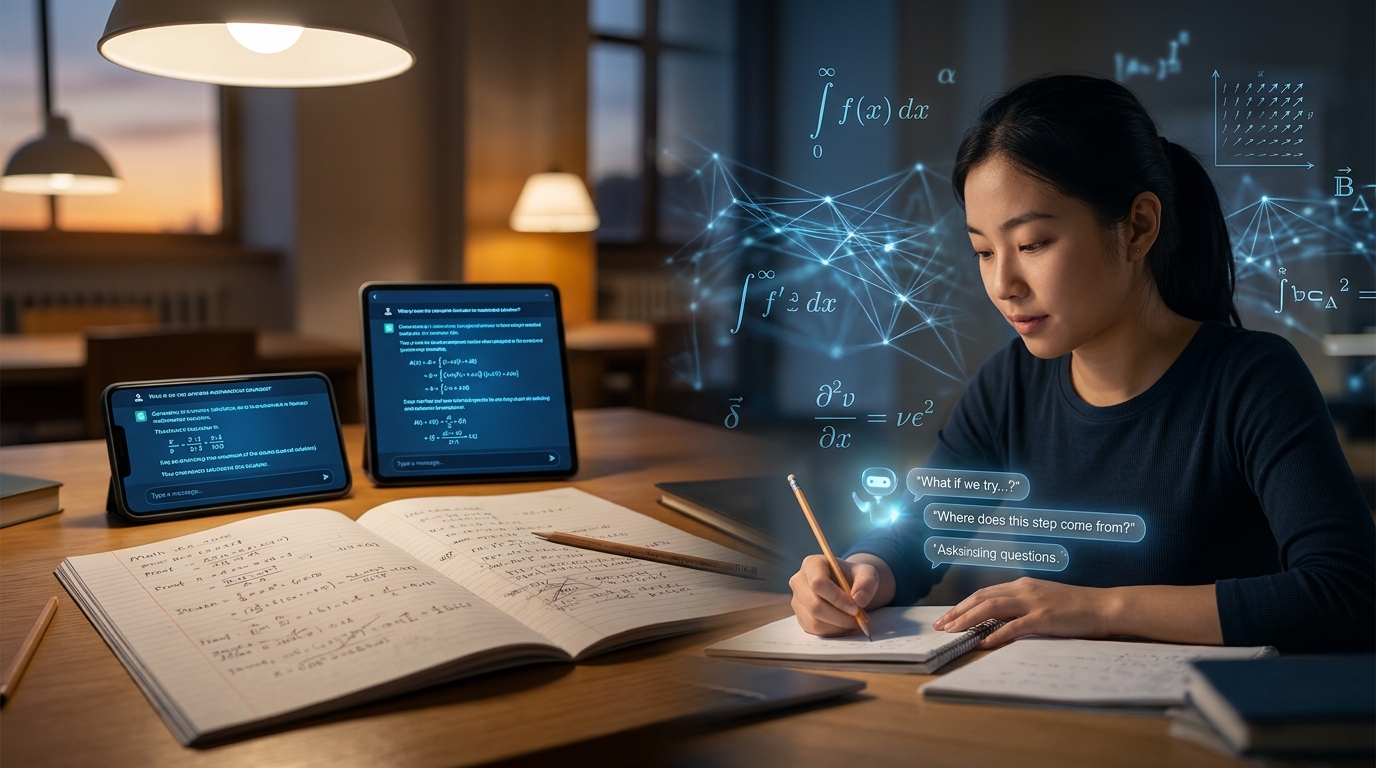
Our core methodology is deliberately Socratic. When a student is stuck, EduQ AI does not hand over the solution. It asks questions:
-
What have you already tried?
-
Which part of the problem feels unclear?
-
Can you restate the question in your own words?
-
What would happen if we simplified one of the conditions?
The goal is to keep the student in the productive struggle zone—the space where real learning occurs—while providing just enough scaffolding so they do not become discouraged and quit.
This approach is reinforced by another design choice: we treat handwriting and written work as first-class citizens. Students can photograph a handwritten worksheet or problem set. EduQ AI's visual understanding analyzes their actual work—diagrams, crossed-out attempts, partial solutions—and responds accordingly. The AI then guides them while they continue writing on paper. This is not incidental. Research from the Norwegian University of Science and Technology has shown that handwriting creates richer neural connectivity and stronger memory encoding than typing. We designed EduQ AI to amplify that process rather than replace it.
What This Looks Like in Practice
Imagine a secondary-school student working through a challenging algebra or calculus problem. Instead of receiving a complete solution, they receive a sequence of targeted questions and hints that surface their misconceptions. Progress is tracked not by how many answers match the key, but by how the student's reasoning evolves over time. Parents and teachers see evidence of genuine understanding rather than polished final products that may or may not reflect the student's own thinking.
This is the opposite of the dynamic Borcherds observed. In one model, AI makes traditional grading obsolete by flooding the system with correct answers. In the other, AI makes traditional grading less necessary by focusing assessment and support on the thinking process itself.
Navigating the Transition
Borcherds is right that the academic system contains considerable inertia. Syllabi, departmental norms, and institutional habits change slowly. Yet the underlying capability shift is already here. Students have powerful AI tools. Teachers and parents need tools that are equally powerful—but aligned with the goal of developing independent thinkers rather than efficient answer generators.
EduQ AI is our contribution to that alignment. It does not claim to solve every problem of assessment in higher mathematics. It does, however, offer a practical methodology for the years of foundational learning that come before students reach a Berkeley lecture hall: personalized, Socratic, handwriting-aware guidance that keeps the student in the driver's seat.
The future of education will not be defined by whether AI can solve homework. It will be defined by whether we use AI to help students learn how to think when the answers are no longer the scarce resource.
Stay curious, stay connected.
– The Wisdom Link AI Team